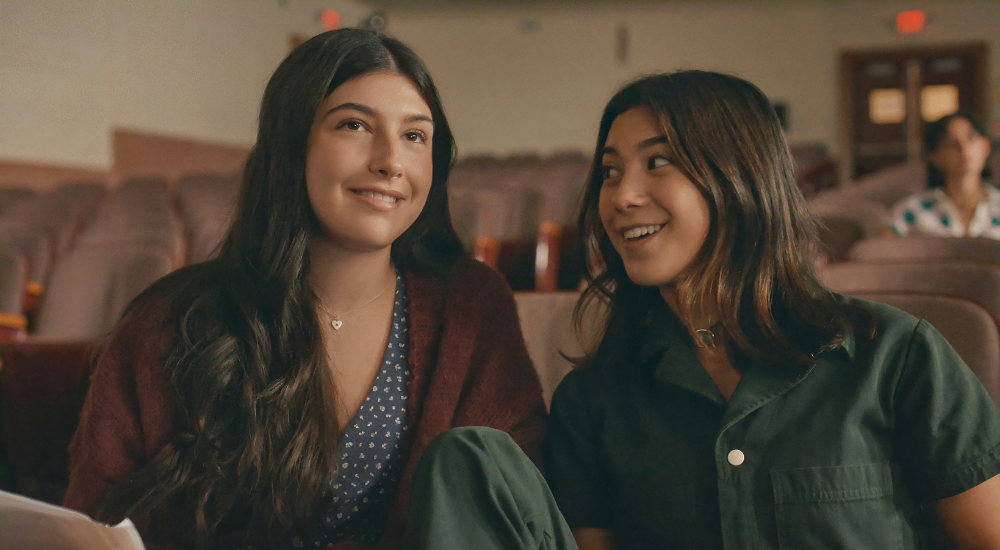

Sunny Sandler is stepping fully into the spotlight, and critics are largely convinced she’s earned it. “Don’t Say Good Luck,” which begins streaming Friday, August 14, has landed to a rare wave of near-unanimous praise, with all twelve of its early reviews registering positive and an aggregate score settling in the “generally favorable” range on ROTTEN TOMATOES, a reception uncommon even by the standards of Netflix’s crowded original-film slate.
Director Julia Hart, known for “Fast Color,” built the film around Sophie Birenbaum, a devoted theater kid who lands the lead role in her school’s production of “Waitress” just as her mother’s cancer returns. The story mirrors real events from the life of the film’s co-writer, who landed the lead in her own high school musical at the same time her own mother’s illness resurfaced, according to production background shared on NETFLIX TUDUM.
Sandler, 17, has quietly built a résumé of more than two dozen film credits through family projects, but this is being described as the role that finally makes her impossible to overlook. In its review, VARIETY argues that where past appearances left her blending into the background, here she becomes the warmly awkward, believable center of the film, matched beat for beat by Melanie Lynskey as her ailing mother, Elizabeth. That dynamic carries the film’s most affecting stretch, including a climactic musical number where Sophie performs a ballad from the actual “Waitress” score, a sequence multiple critics flagged as the film’s emotional peak.
Not every element landed cleanly. SCREEN Rant’s review pointed to uneven pacing in the film’s first act and a subplot involving Sophie’s best friend abruptly quitting the school play that the outlet felt was left underexplained. In a three-star writeup, FLICKERING MYTH singled out a recurring bit involving Sophie’s father repeatedly butt-dialing her as a contrived device for feeding the audience plot information, even while praising the film’s overall emotional honesty. Neither critique has done much to dent the broader consensus that the film’s central performances carry it past its structural rough patches.
The project marks a tonal shift for its producing banner, best known for broad studio comedies but increasingly leaning into more personal, dramatic material as Sandler family members move into more prominent roles both on-screen and behind the camera. That shift shows in the film’s supporting cast, which includes Max Greenfield, Stephanie Beatriz, Steve Buscemi, Bebe Neuwirth and Jon Lovitz.
The takeaway across most reviews is straightforward: DEADLINE sums up the appeal as a coming-of-age story that doesn’t shy away from grief but doesn’t let it swallow the film either, using the rehearsal-hall energy of its musical to keep things from tipping into misery. “Don’t Say Good Luck” streams on Netflix starting Friday.
