
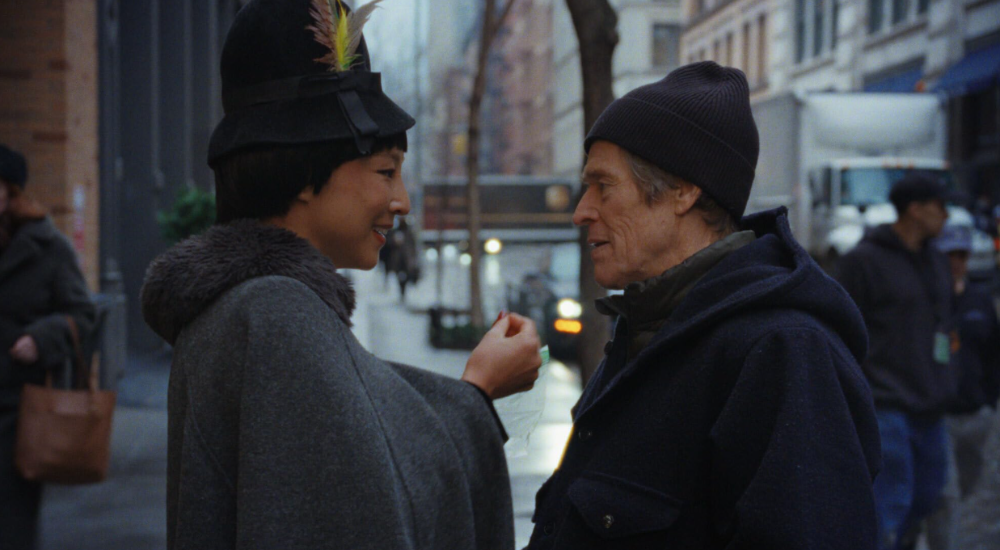

“I used to be the youngest person in every group,” poet Ed Saxberger says at one point in “Late Fame.” “Then one day, I became the oldest.” That line, quoted in RogerEbert.com’s review, sits close to the emotional center of Kent Jones’s second narrative feature, which opened in theaters August 7 from Magnolia Pictures.
A Postal Worker’s Forgotten Past
Willem Dafoe plays Ed, a man who’s spent nearly 40 years working the same Manhattan mailroom. Decades earlier, in 1979, he published a slim poetry collection called “Way Past Go” that earned a handful of favorable reviews and then quietly disappeared from view — along with any version of Ed that thought of himself as a writer. According to Deep Focus Review, his days now run on a quiet loop of work, a homemade tuna sandwich, and pool with the same old friends at a neighborhood bar.
That loop breaks when a twenty-something stranger who introduces himself as Meyers, played by Edmund Donovan, approaches Ed outside his apartment building. Meyers has read “Way Past Go,” and he wants Ed to meet the group of young creatives he runs with — a self-styled collective calling itself the Enthusiasm Society, dedicated to reviving the kind of underground art scene Ed briefly belonged to decades earlier.

An Ensemble of Aspiring Poseurs
The film gets a lot of its texture, and its comedy, from that group. Deep Focus Review describes them as mostly white, twentysomething men playing dress-up as intellectuals — one member wears a cape without a trace of irony, another affects a Bolshevik look, complete with a shaggy beard and suspenders, despite living in a penthouse. The A.V. Club’s review frames the whole ensemble as people deluding themselves, though so thoroughly and, at moments, so movingly, that the film never quite lets the audience feel superior to them.
Greta Lee co-stars as Gloria, described across multiple reviews as a mercurial actress who becomes entangled with Ed’s rediscovery. Jake Lacy also appears in the cast, alongside Clay Singer, Clark Johnson, Luca Padovan, Arthur Langlie, Graham Campbell and Tony Torn.
Dafoe’s Quiet, Unshowy Performance
Nearly every review singles out Dafoe’s work here as a departure from the eccentric, heavily stylized roles he’s known for in films by Wes Anderson or Robert Eggers. Deep Focus Review calls it a rare “everyman” performance that he slips into with total ease, capturing Ed’s inner conflict as he’s pulled between wanting to please his new friends and sensing, correctly, that something about the whole arrangement doesn’t quite fit.
Time’s review frames the performance around a bigger question the film is asking — how many lives a person can fit into one lifetime, and what’s actually left of someone once the identity they built their life around has quietly expired. Dafoe, in that review’s assessment, plays a man who’s made peace with what his life became, only to be shaken by the possibility that he hasn’t, not really.
A Story Rooted in Vienna, Relocated to Soho
“Late Fame” is adapted from Arthur Schnitzler’s 1890s novella of the same name, with screenwriter Samy Burch — who earned an Oscar nomination for “May December” — shifting the setting from turn-of-the-century Vienna to present-day Soho, once a hub for downtown artists and now, as Deadline’s review puts it, something else entirely. Deadline’s review frames the film as being just as much about a version of New York that’s largely vanished as it is about Ed himself.
The film premiered at last year’s Venice Film Festival, more than a year before its theatrical release, and picked up an award at October’s Viennale, according to details compiled on the film’s Wikipedia page. Magnolia acquired distribution rights in December.
Where Critics Land
Reception has been strongly positive without being uniformly rapturous. Metacritic’s aggregation puts the film comfortably in favorable territory, with Screen Daily calling it a sharply observed look at the thin line between real creative ambition and empty posturing, and The Guardian describing it as a warm, lived-in New York story. Peter Travers’s review, also collected on Metacritic, credits Dafoe with delivering a master class in balancing a rediscovered artist’s mind and heart, even as the character struggles to find where he actually stands between the two.
TheWrap’s review, also gathered in that roundup, notes the film manages to mock its characters’ pipe dreams and sympathize with them in the same breath, all while making clear that Ed’s original poetry was genuinely worth taking seriously in the first place — a needle Kent Jones threads carefully rather than picking a side.
Final Words
“Late Fame” isn’t chasing a big emotional payoff or a tidy redemption arc. It’s a smaller, more specific film about what happens when a person’s old identity resurfaces just as they’ve made peace with having buried it — and whether that resurfacing is a gift or a trap depends, this film suggests, on who’s doing the reviving.
“Late Fame” is now playing in select theaters from Magnolia Pictures, with a runtime of 96 minutes.
